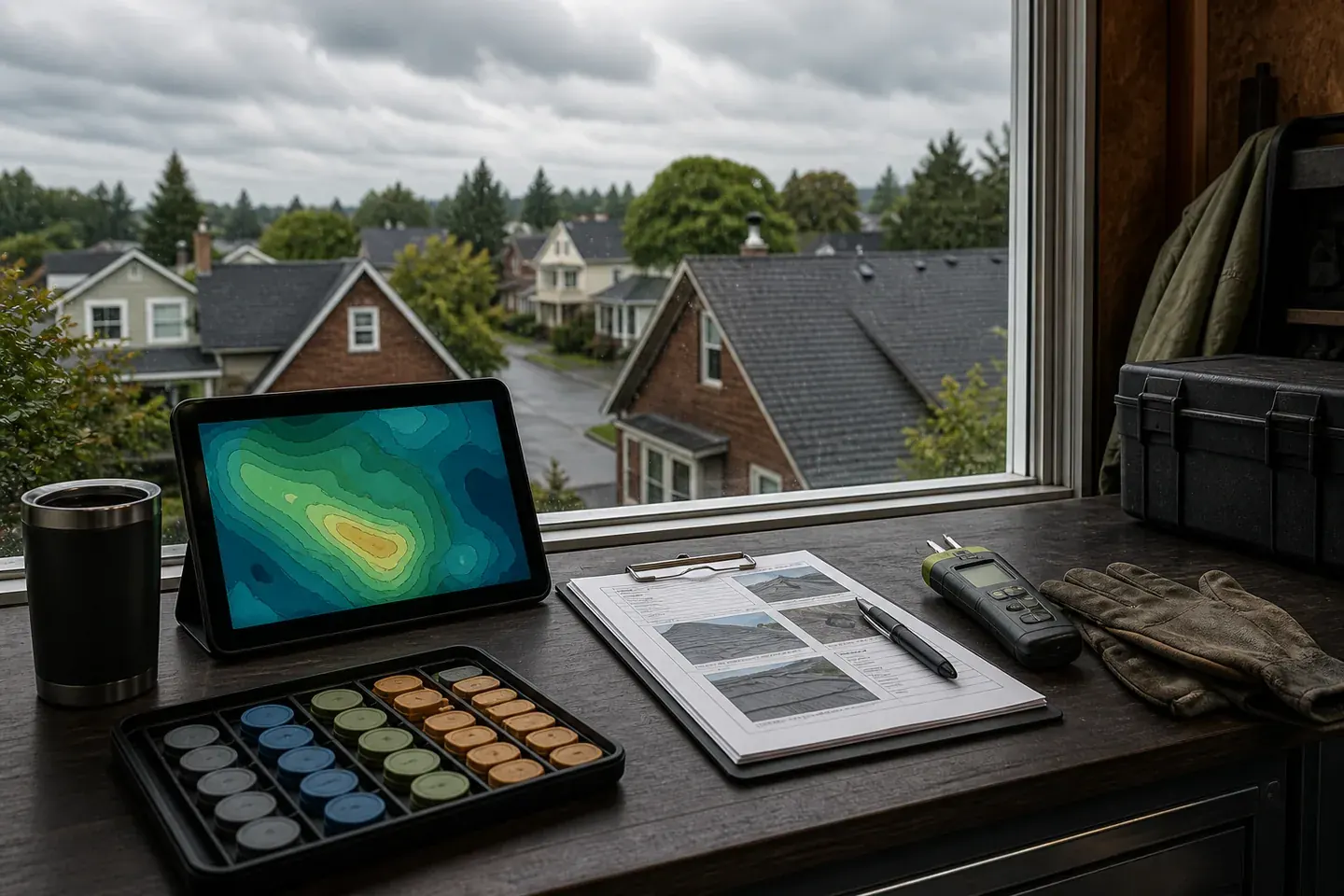
How should you choose the message from the storm stage?
Before impact, share official preparedness sources, how customers can protect documents, and how to reach the business later. During an active warning, do not compete with public-safety information or encourage unsafe inspection. After the danger passes, explain how the company triages requests and what an inspection can and cannot establish. Later, use permissioned job evidence to teach without implying every nearby property has damage.
Build the stage into the approval record with a timestamp, official source, covered service area, operational owner, capacity check, and expiration. National Weather Service social channels are supplemental; link customers to weather.gov or the relevant official alert source for current warnings. A reusable storm graphic without a source and time can become misinformation as conditions move.
How should you separate weather evidence from property evidence?
A storm report may justify a general inspection reminder, but it does not prove damage to a particular roof. Ban captions that announce a homeowner needs replacement, has hail damage, or qualifies for coverage before an appropriate inspection and insurer decision. Use precise language: conditions occurred in a defined area; the company can explain its inspection process; findings depend on the property.
Create an evidence ladder: official forecast or warning, verified company capacity, on-site inspection record, permissioned job photographs, written scope, and completed-work documentation. Each content claim must stop at the highest supported rung. A map supports preparedness; an inspection supports property-specific observations; a completed project can support process proof, but none automatically supports an insurance promise.
How should you make customer protection part of the marketing?
Disaster periods attract contractor fraud, so trustworthy content should reduce pressure rather than exploit it. State licensing, insurance, contract, cancellation, and solicitation rules vary; the company should supply current approved language and point to the appropriate public resources. Do not borrow badges, imply government or insurer affiliation, or tell customers that an adjuster will approve work.
Publish what the customer can verify: legal business name, real contact route, current service area, inspection steps, who will arrive, how identification works, what documents are provided, and where complaints or changes go. Avoid countdowns unrelated to actual capacity, unverified neighborhood claims, and fear-based door-knocking language. The strongest trust signal is a process a homeowner can inspect.
How should you use a publish, update, pause, or replace decision tree?
Publish when the source, stage, service area, capacity, claim, destination, and approver are current. Update when the core message remains true but hours, phone routing, arrival window, or geography changed. Pause when safety, capacity, or evidence is unclear. Replace when a scheduled promotional post is tone-deaf beside an active emergency or routes customers to an unstaffed destination.
Give every storm item a recheck time measured in hours, not weeks. Assign one operations owner to confirm crew and phone capacity and one content owner to update profiles and scheduled queues. Keep a log of the prior version, reason, final live links, and takedown time. A provider that cannot stop scheduled content quickly should not control the storm-response lane.
How should you work through a capacity example?
Suppose a company normally handles twenty inspection requests weekly, has six open slots, and serves three counties. After a hail event, it receives forty inquiries in one day. The correct CTA is not immediate inspection. The company publishes the covered counties, explains its triage and callback process, stops a broad seasonal promotion, and removes time claims when the six slots fill.
Measure answered calls, valid service-area requests, booked inspections, unreachable leads, correction time, and customer complaints separately. High engagement from people outside the service area is not success. The next content decision might be an honest waitlist update, a self-documentation checklist approved by operations, or a pause until the business can fulfill the response it advertises.
How should you choose a vendor by its restraint under pressure?
Ask a social media provider to simulate a changing warning, a full inspection calendar, an insurer question, an unverified roof photo, and a customer asking whether it is safe to climb. The provider should cite official safety information, avoid remote diagnosis, route insurer and property decisions, change the CTA, and preserve the incident record. Speed without these controls increases risk.
Start the provider on evergreen education and preapproved preparedness material. Expand into live storm content only after roles, monitoring windows, escalation contacts, account access, and pause authority are tested. At review, choose continue, expand one stage, repair the workflow, or remove access. Do not buy an always-on promise that the business cannot safely staff.
What does current guidance change about this plan?
We reviewed current National Weather Service preparedness and alert-channel material, 2026 insurance-industry contractor-fraud guidance, FTC advertising standards, and first-party profile and scheduling controls. We synthesized them into a four-stage storm decision tree tied to official sources, property evidence, crew capacity, and an expiring customer action.
Social weather updates are supplemental to official warnings
The National Weather Service encourages preparedness communication while directing people to official forecasts and warnings, which can change faster than a reusable promotional asset.
How to apply itTime-stamp and link official sources, prioritize safety during danger, and assign every storm-related post a short recheck and takedown window.
Review National Weather Service: Social media preparednessPost-disaster urgency can increase fraud exposure
Current Insurance Information Institute material describes recurring contractor-fraud patterns after disasters when urgency, confusion, and customer vulnerability increase in a fast-moving recovery market.
How to apply itUse verifiable business identity, transparent inspection steps, honest capacity, and no insurer-affiliation or coverage promises instead of fear-based scarcity.
Review Insurance Information Institute: Contractor fraud after disasterWeather evidence does not prove property damage
FTC advertising principles require an appropriate basis for objective claims, so a regional storm report cannot substantiate a diagnosis, repair need, insurer decision, arrival time, or result for an individual property.
How to apply itUse an evidence ladder that separates official conditions, operational capacity, inspection findings, documented scope, and completed-work proof before writing the claim.
Review FTC: Advertising FAQs for small businessWhich useful examples can you adapt?
These are not fake captions to copy word for word. Use them as structure, then replace the proof, timing, and CTA with real business details.
For a DIY-versus-service decision, compare the next campaign, available source files, editing time, required formats, deadline, and ownership after delivery.
Replace every detail with the current business facts, then keep only the evidence needed to choose the smallest path that gets the campaign published.
The company has normal capacity and an official watch covering part of its service area.
Publish preparedness and contact information with the source and timestamp, while setting a recheck before the next scheduled post.
A promotional financing post is scheduled while a local warning and dangerous conditions are active.
Pause the promotion, direct people to official alerts, and prohibit staff or customers from unsafe roof inspection for content.
Which authoritative sources should the practice review?
Use these sources as a starting point, then follow the laws, professional rules, and qualified advice that apply to the practice and its location.
- National Weather Service: Social media preparedness NWS source material for official forecasts, warnings, preparedness messages, and weather-aware social communication.
- Insurance Information Institute: Contractor fraud after disaster Current insurance-industry guidance on recurring contractor-fraud risks after storms and other disasters.
- FTC: Advertising FAQs for small business FTC guidance on truthful advertising, objective claims, disclosures, and the evidence businesses should keep.
- Google Business Profile: Create and manage posts Google's documentation for Update, Offer, and Event posts, scheduling, media, buttons, and post status.
- Google Business Profile: Owners and managers Google's role-based access guidance for managing posts and reviews without sharing a password.
- Meta: Schedule and manage Facebook Page posts Meta's current instructions for scheduling, rescheduling, drafting, and reviewing Page posts in Business Suite.
- Meta: About Facebook Page access Meta's current explanation of full-control, partial-control, task, content, message, advertising, and insight permissions for Pages.