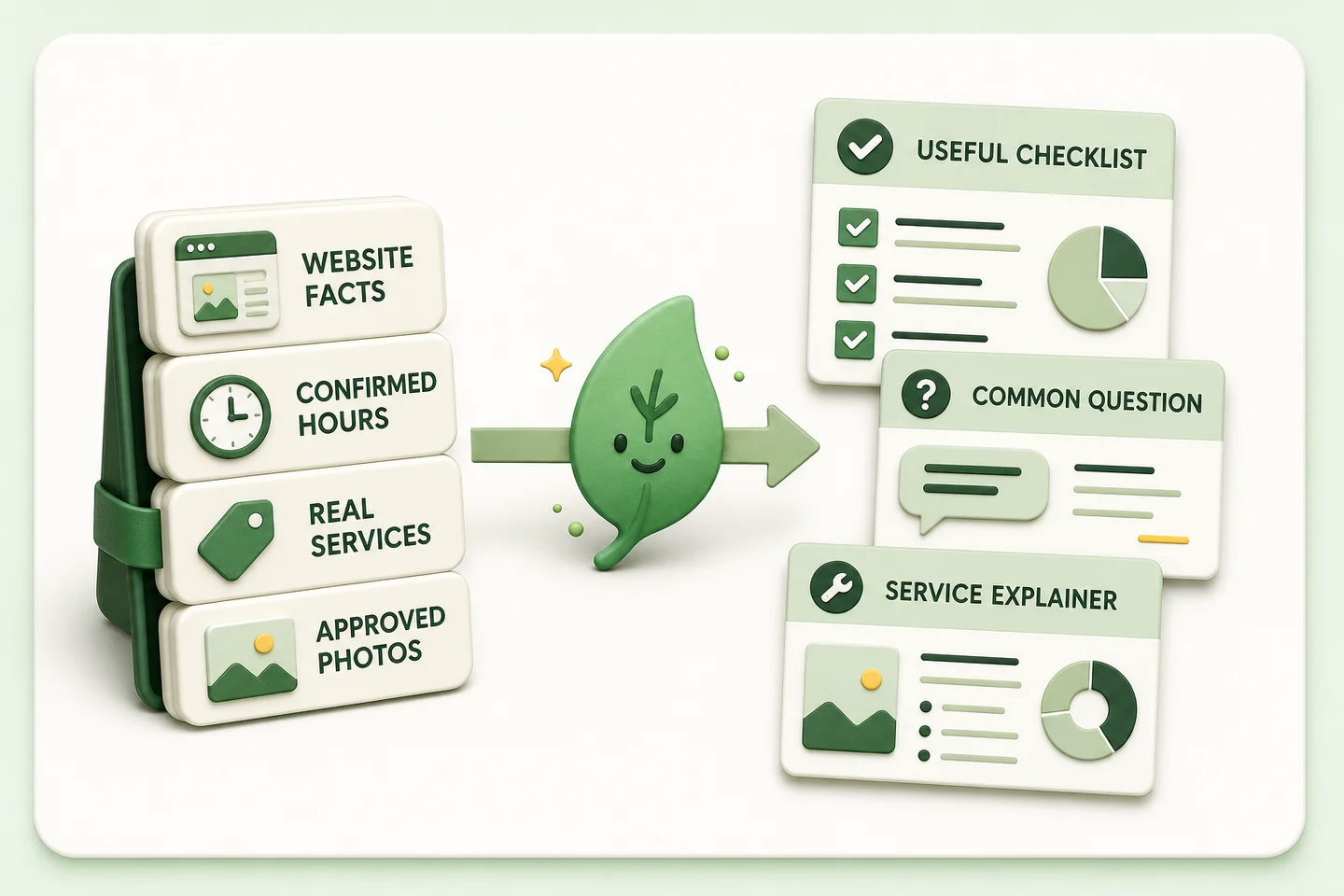
How should a manager define strategy as recurring decisions?
Strategy should identify the customer, offer, proof, current priority, channel role, content jobs, CTA, and measurement plan. A monthly list of motivational themes is not enough. The manager should be able to explain why each piece exists and which business input supports it.
Ask how the plan changes when an offer expires, a service changes, a location closes, a customer question repeats, or a platform connection fails. A useful strategy includes exception handling and an accountable decision owner.
Which source and claim controls should be required?
The manager needs a source of truth for services, prices, hours, locations, booking links, policies, approved claims, reviews, images, permissions, and offer dates. They should not infer current facts from an old post or invent a plausible detail to fill the design.
The approval workflow should identify which claims need evidence and which industries require a qualified reviewer. FTC guidance applies to advertising claims, endorsements, and reviews even when the content feels informal.
How should planning and production be separated?
Planning decides the sequence and purpose. Production turns the plan into finished graphics, carousels, simple videos, captions, native fields, crops, accessibility text, and destination links. Confirm exactly which formats are included and whether the manager delivers drafts, editable templates, or publish-ready assets.
Specify source-material deadlines, revision rounds, approval timing, and what happens when the owner is late. Without these details, the manager may be blamed for missing inputs or the business may be billed for repeated scope changes.
How should account access and publishing be controlled?
Use role-based platform access instead of sharing a primary password whenever the platform supports it. Google allows owners and managers to create posts, respond to reviews, and view insights without sharing one login. Keep the business as the owner of its accounts, domains, analytics, and source assets.
Document who can draft, approve, schedule, publish, reschedule, pause, and delete. Include a failure path for expired tokens, rejected posts, broken links, incorrect dates, and urgent business changes. Publishing authority should be narrower than content creation authority.
What boundaries should apply to engagement and handoff?
Define which public comments, messages, and reviews can receive a routine response and which must move to the owner. Complaints, refunds, disputes, threats, safety issues, private customer details, regulated advice, negotiation, and sales closing usually need a responsible person rather than a generic automation rule.
The handoff should include context, urgency, destination, and status without exposing more personal information than necessary. Review common questions each month so recurring safe answers can be approved while sensitive cases remain protected.
What should reporting cover beyond engagement?
A manager should report what was planned, approved, published, delayed, corrected, and learned. Performance reporting should distinguish reach and engagement from qualified actions such as calls, bookings, quotes, orders, visits, or applications. It should also name attribution limits.
Include operational measures: approval turnaround, source gaps, publishing failures, response backlog, expired offers, and owner handoffs. A beautiful performance deck can hide a fragile workflow if these signals are missing.
How should a business compare the complete scope before buying?
Compare providers line by line: strategy, number and type of assets, channels, source collection, design, captions, revisions, approvals, publishing, routine engagement, reporting, access, ownership, turnaround, cancellation, and exclusions. Ask to see the actual workflow rather than relying on labels such as full service or AI powered.
Price becomes easier to interpret when responsibilities are explicit. A lower fee may leave the owner doing the research, photography, design revisions, publishing, and replies. A higher fee may still be poor value when claims, access, escalation, and measurement are undefined.
What does current guidance change about this plan?
We reviewed role-based platform access, publishing controls, analytics definitions, and advertising obligations. The resulting checklist evaluates the manager as an operating system with explicit authority and handoff boundaries.
Role-based access is safer than password sharing
Google allows owners and managers to create posts, respond to reviews, edit information, and view insights while each person uses a separate account.
How to apply itKeep the business as primary owner, grant the narrowest workable role, and document access removal as part of provider offboarding.
Review Google Business Profile: Owners and managersPublishing control needs a visible failure path
Meta's scheduling workflow supports editing, rescheduling, moving items to drafts, and deleting scheduled posts, demonstrating that publication is a managed state rather than a single upload action.
How to apply itName who can approve, schedule, pause, correct, and remove content when an offer changes or a platform connection fails.
Review Meta: Schedule and manage Facebook Page postsThe manager remains accountable for advertising claims
FTC guidance requires truthful, non-misleading advertising and adequate support for objective claims regardless of whether production is internal, outsourced, or AI assisted.
How to apply itRequire a source record and approval owner for prices, performance claims, comparisons, reviews, incentives, dates, and regulated statements.
Review FTC: Advertising FAQs for small businessWhich useful examples can you adapt?
These are not fake captions to copy word for word. Use them as structure, then replace the proof, timing, and CTA with real business details.
For a template or content-service comparison, score the next campaign by deadline, source-material readiness, editing confidence, formats, and handoff needs.
Replace every detail with the current business facts, then keep only the evidence needed to compare the usable scope and choose the right production path.
Which option removes the actual production bottleneck?
Answer with one approved input from real photos, offer facts, brand details, CTA language, and honest source material supplied by the buyer. Do not add a claim that the source material cannot support.
What will still need to be written, edited, approved, or published after purchase?
Use the caption to remove that friction, then tell the reader how to compare the usable scope and choose the right production path without introducing a second CTA.
Which authoritative sources should the practice review?
Use these sources as a starting point, then follow the laws, professional rules, and qualified advice that apply to the practice and its location.
- Google Business Profile: Owners and managers Google's role-based access guidance for managing posts and reviews without sharing a password.
- Meta: Schedule and manage Facebook Page posts Meta's current instructions for scheduling, rescheduling, drafting, and reviewing Page posts in Business Suite.
- Meta: See insights for Facebook Page posts Meta's first-party description of post reach, engagement, and Business Suite content insights.
- LinkedIn: Page content analytics LinkedIn's definitions for impressions, reach, clicks, engagement, video performance, and Page content reporting.
- FTC: Advertising FAQs for small business FTC guidance on truthful advertising, objective claims, disclosures, and the evidence businesses should keep.
- FTC: Endorsements, influencers, and reviews FTC resources for testimonials, material connections, consumer reviews, and endorsement disclosures.
- FTC: Consumer Reviews and Testimonials Rule Q&A FTC answers covering fake reviews, incentives, review suppression, insider testimonials, and reuse in advertising.